Find the Bottleneck First
Business software conversations often start like this:
“We need a CRM.”
Or:
“We want to automate everything.”
That’s completely normal.
Separate Excel files, WhatsApp groups, and disconnected software eventually become a burden for the team.
But when I have this kind of conversation, I don’t start by thinking about which software we should choose.
First, I try to understand where the process is getting stuck.

The Problem Is Often Not the Tool
Sometimes the CRM works.
There is an inventory system too.
Payments are tracked separately.
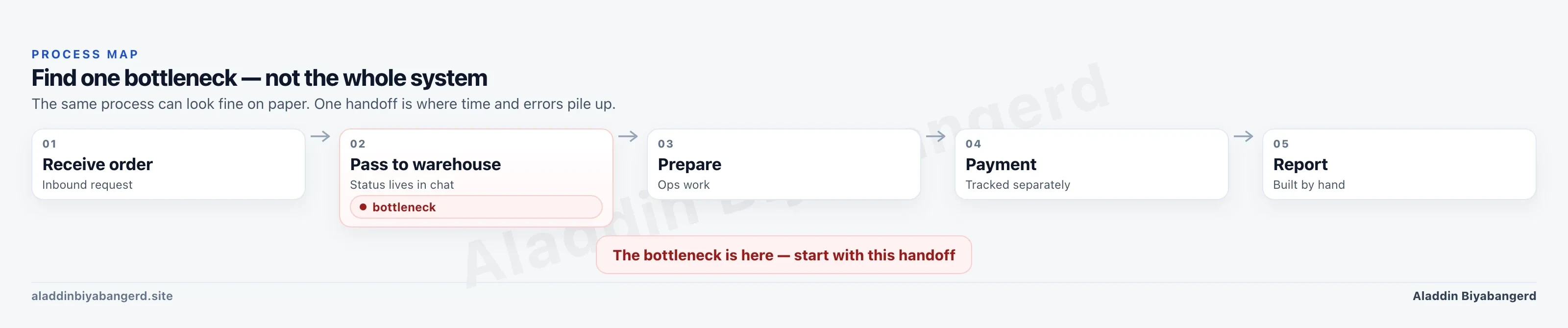
But the order comes in through one system, its status is updated somewhere else, and the report is manually prepared at the end of the day.
In situations like this, adding another piece of software doesn’t necessarily solve the problem.
Because the main delay usually isn’t inside one screen.
The real bottleneck is often in the handoffs.
When data has to be moved from one system to another.
When the same information has to be entered twice.
When someone has to wait for an approval.
When the team has to be asked just to find out what is happening.
Where Is the Bottleneck?
To me, a bottleneck is the part of a process that creates the most time loss, errors, or unnecessary pressure.
Sometimes it is receiving the order.
Sometimes it is passing the order to the warehouse.
Sometimes it is tracking the payment.
And sometimes it is simply not being able to answer the question:
“Where exactly is this order right now?”
That’s why the first question isn’t:
“What are we going to build?”
The first questions are:
- Where is the team losing the most time today?
- Where is the same information being entered twice?
- Which step exists only in one person’s memory?
- Who does the manager have to message to understand the current situation?
- Which delays directly affect the customer?
These questions reveal much more than a feature list ever could.
You Don’t Need to Automate Everything at Once
A common approach is to start with a large system.
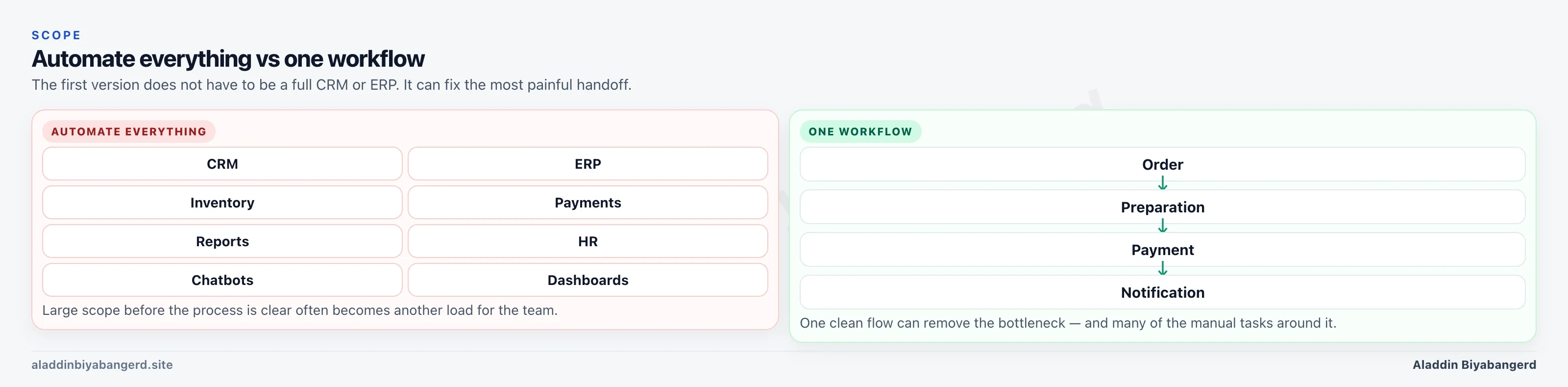
A complete CRM.
A complete ERP.
Every module.
Every report.
But if the business doesn’t fully understand its own processes yet, a large system can easily become another source of complexity.
There is a safer approach.
Fix one workflow first.
For example:
Order → Preparation → Payment → Notification
Or:
Request → Approval → Reservation → Reporting
It may look small.
But the right workflow can have an impact on the entire operation.
Because once the bottleneck is removed, many of the manual tasks around it start to disappear as well.
Measure First, Then Scale
Once one workflow is up and running, the next step becomes much clearer.
Because now you have real usage data instead of assumptions.
Which status is missing?
Which report is actually needed?
Which integration genuinely saves time?
Which part is still being handled manually?
At this point, adding new parts to the system becomes much more justified.
For me, the right sequence is:
Map the process → Find the bottleneck → Build one workflow → Put it into use → Measure → Then scale
Technology comes later in this sequence.
Java, Spring Boot, APIs, databases — these are tools.
The real challenge is understanding where the business is getting stuck.

The Bottom Line
Sometimes a business really does need a large system.
But often, that’s not what it needs first.
What it needs first is to identify the bottleneck in the process.
Because a good system is not necessarily the one that covers everything.
A good system is one that solves the most painful part of the operation — and can then grow as the business needs evolve.