Working in Banking Taught Me Why Accuracy Matters
When you work in banking, one thing becomes clear very quickly:
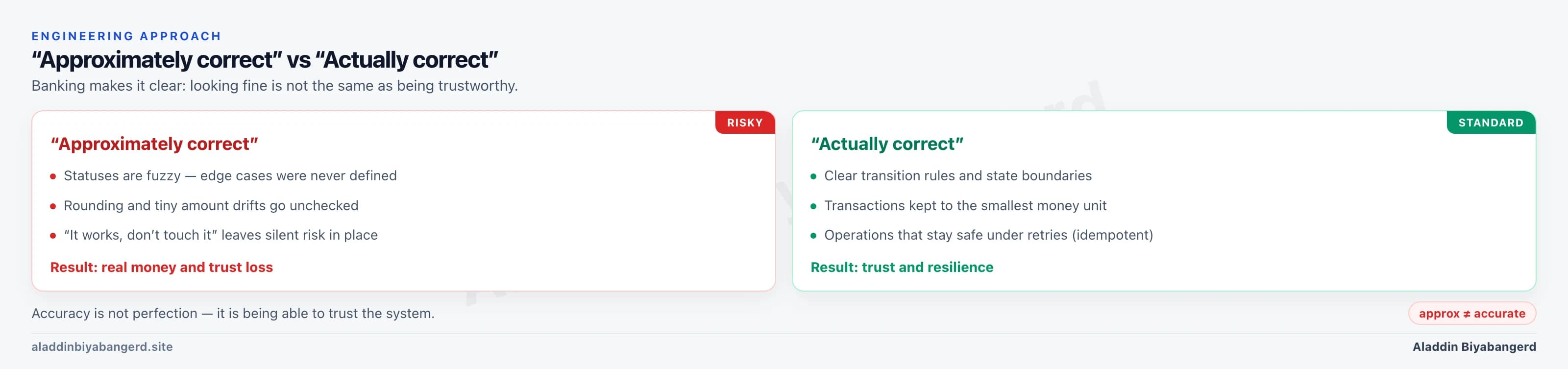
“Approximately correct” is not good enough.
A wrong amount, an incorrect status, a wrong date, or an invalid transition doesn’t simply remain a “small bug.”
It can have real consequences.
The most important thing I’ve learned from working in this environment is not about choosing the right technology.
It’s this:
A system looking correct is not the same as a system actually being correct.
Accuracy Starts With Rules
When a new requirement comes in at a bank, the first question isn’t:
“How do I code this?”
First, you need to understand:
- What exactly does this operation change?
- What state does it move from, and what state does it move to?
- Who is allowed to perform it?
- What must not be changed?
- How should the system behave when something goes wrong?
Because if the rule itself is unclear, even clean and well-written code won’t guarantee a reliable result.
I now start from the same place when working on projects outside banking:
First, I clarify the process and its boundaries. Then I write the code.
“It Works” Is a Low Standard
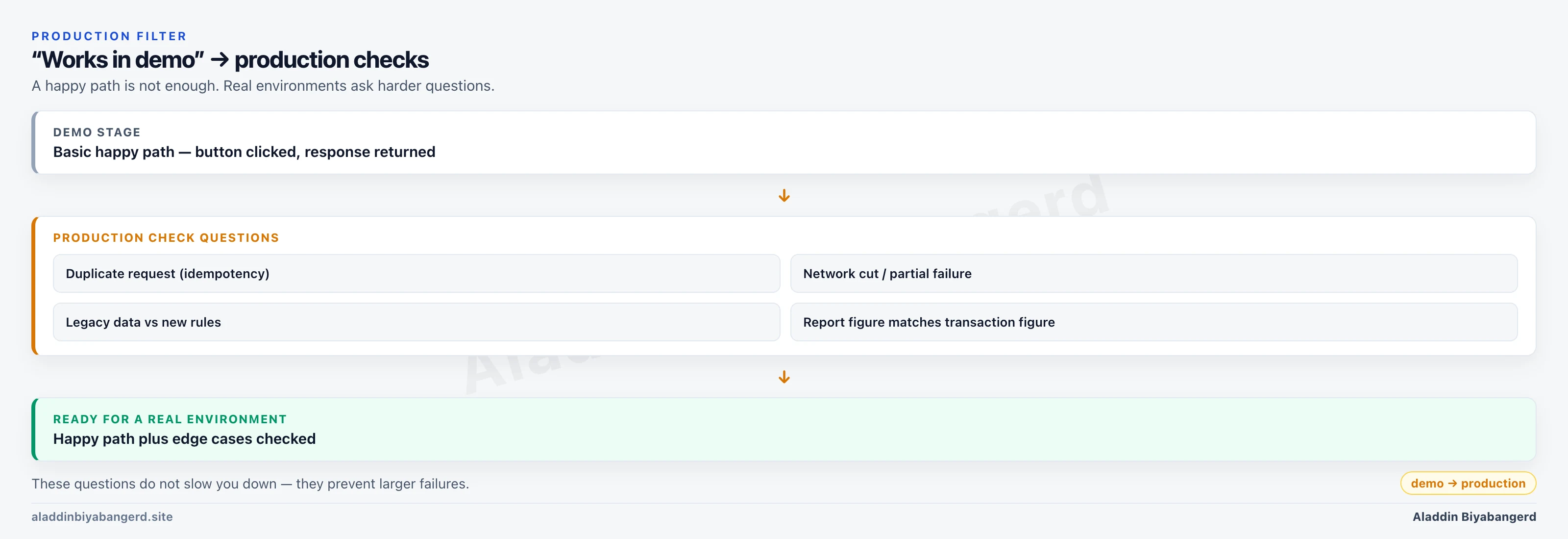
A system can work in a tutorial or during a demo.
But in a real environment, “it works” needs to mean much more.
For example:
- What happens if the same operation arrives twice?
- What happens when a partial response is received?
- What happens when existing data doesn’t comply with a new rule?
- Does the number shown in the report match the number recorded in the actual transaction?
These questions don’t slow me down.
They help prevent much bigger problems later.
Silent Errors Are the Most Dangerous
Some errors are obvious.
The screen turns red, an exception is thrown, and the process stops.
The more dangerous situation is different:
The system shows no error, but writes incorrect data.
Wrong status.
Wrong amount.
Wrong relationship.
And then everyone starts trusting that data as if it were correct.
Banking makes this risk especially visible.
But the same risk exists in reservations, payments, inventory, and order workflows.
That’s why I don’t ask only:
“Did the code work?”
I also ask:
“After this operation, is the information the system knows still correct?”
Changing a Working Process Is a Different Kind of Work
Building a new system is one thing.
Changing a process that people rely on every day is something else entirely.
You feel this much more clearly in banking.
A change shouldn’t only satisfy the new requirement.
It must also avoid breaking behavior that is already working correctly.
So before making a change, I look at a few things:
- How does the process work today?
- Which other workflows will this change affect?
- What will happen to existing data?
- Do we have a rollback path?
This isn’t fear.
It’s responsibility.

This Skill Isn’t Just About Banking
Sometimes people see banking experience as something very specific to one industry.
For me, the most important skill I’ve taken from it applies to software engineering in general:
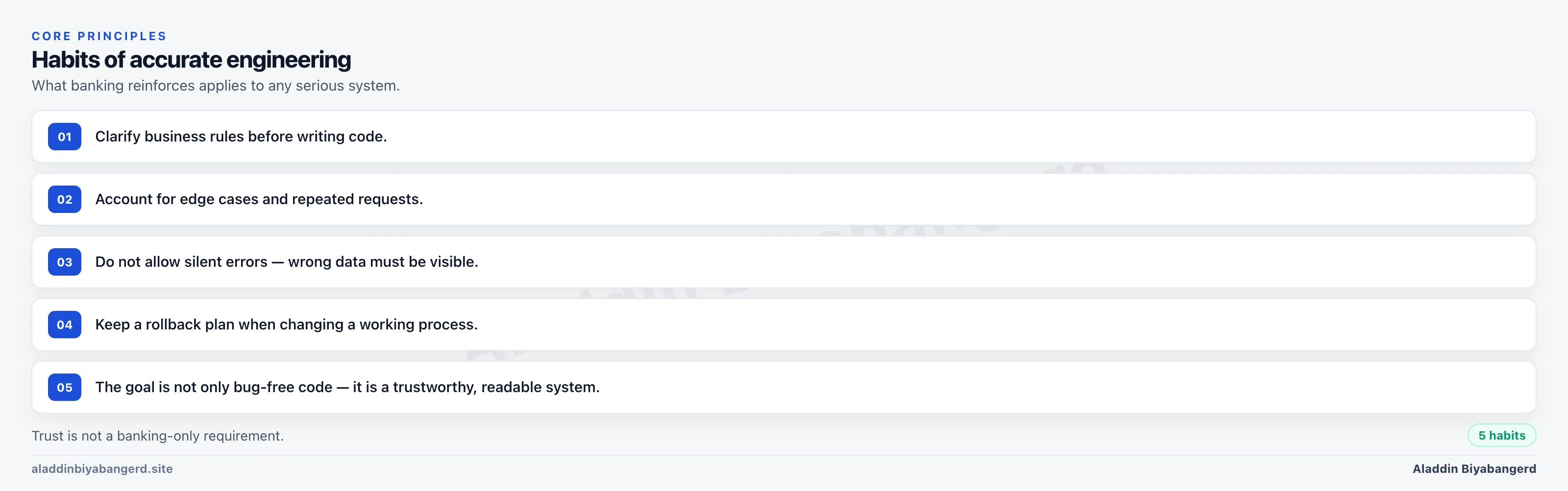
- Clarify the rule first.
- Consider edge cases.
- Be especially careful with silent errors.
- Change working processes carefully.
- Before saying “it’s ready,” make sure the result is actually correct.
The same mindset is needed in business software.
Because wherever there are customers, money, statuses, history, and reporting, “approximately” can be expensive.
What Does Accuracy Mean to Me?
Accuracy doesn’t mean trying to make everything perfect.
To me, it means:
- It’s clear what the system does.
- It’s clear what the system is expected to protect.
- It doesn’t hide errors when something goes wrong.
- If another developer joins the project tomorrow, the rules are still understandable.
So accuracy isn’t just about having no bugs.
Accuracy means being able to trust the system.
The Bottom Line
Working in banking reinforced one simple idea for me:
It’s not enough for software to look good. It needs to remain correct.
I now carry the same standard into projects outside banking.
Because trust, accurate data, and predictable behavior aren’t only important in banking.
They are requirements for any serious system that people are expected to rely on.